Features
Cricket analysis: Are ICC tournaments lacking a certain element of thrill?


The Men’s T20 World Cup is now reaching the business end of the group stages, ahead of the Super 8s, which get underway this weekend.

The Men’s T20 World Cup is now reaching the business end of the group stages, ahead of the Super 8s, which get underway this weekend.
The tournament has delivered some memorable moments so far.
The double super over drama between Afghanistan and South Africa, Zimbabwe upsetting Australia to progress in Group B and the notable efforts of the lower-ranked sides such as USA and debutants Italy which also included Canada’s 19-year-old opening batter Yuvraj Samra becoming the first player from an Associate nation to register a T20 World Cup century when he scored 110 off 65 balls against New Zealand in Chennai.
Seven teams officially qualified with still eight games to play, as all attention turns to Pakistan versus Namibia on Wednesday as Pakistan look to avoid consecutive group stage exits behind rivals India and minnows USA.
The largely dead-rubber feel to the final few days of the group stage has been in part due to the lack of major upsets – despite the best efforts – but also the format of the competition, with nearly all of the upcoming Super 8 contests already revealed months ago.
Whereas in most other sports, teams would now be heading into do-or-die territory after a group stage, in cricket, the qualified teams now reset for another group stage in which one slip-up may still not prove terminal.
For exclusive stories and all the detailed cricket news you need, subscribe to The Cricket Paper website, digital edition, or newspaper from as little as 14p a day.
FOLLOW OUR LIVE SCORES CENTRE FOR T20 WORLD CUP UPDATES
The ‘super’ stage
A second group phase has been a mainstay at ICC global events, particularly in the T20 World Cup.
In the four editions between 2014 and 2022, the higher-ranked sides only entered the competition in the ‘Super 10 or 12’ stage, after the smaller nations battled it out in a preliminary first round to earn a golden ticket to the main event.
The expansion to 20 teams in 2024 reverted to the original structure, where all competing nations entered into the first group stage, though this time with five teams per group rather than previously three.
This has been a welcome alteration to the format as it not only provides greater exposure and less familiar matchups but also requires the top-ranked sides to earn their spot in the latter stages of the tournament, which has proved to be less than straightforward due to the competitive nature of emerging Associate nations.
An expanded 14-team World Cup in South Africa next year will also reintroduce a ‘Super Six’ stage for the first time since 2003, whereby the top three in both groups progress to a new group to determine a top four.

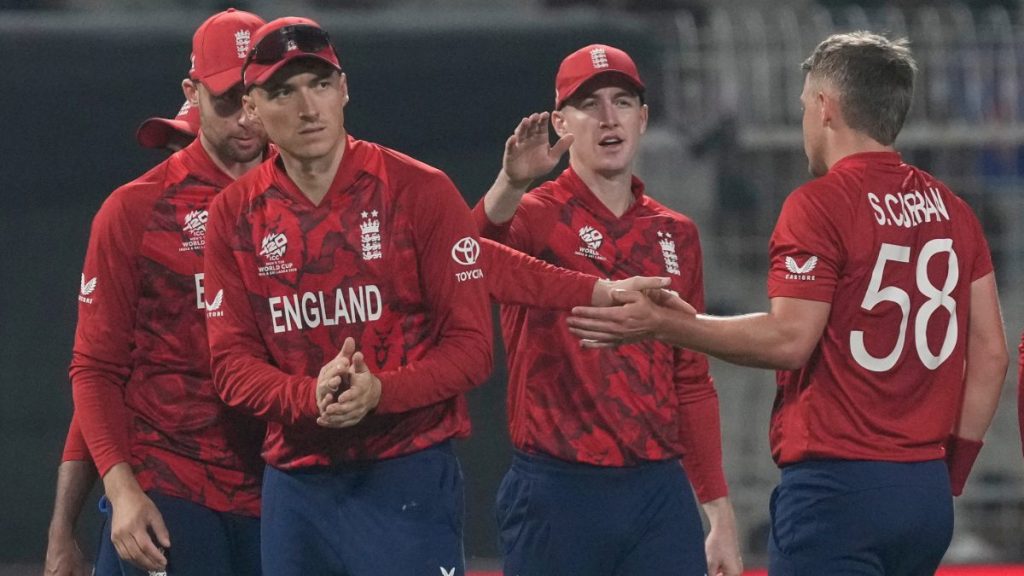
(AP Photo/Bikas Das)
The unique case of cricket
The concept behind the Super 8 stage is a simple one – additional (in theory, more high-quality) matches brings in more money.
It also offers the opportunity for contenders to prove themselves against the best over the duration of three additional group phase games to earn a place in the semi-finals.
However, this is also a means of providing a cushion for the big three, in particular India, to still qualify should they suffer a defeat at this stage of the competition, as despite active efforts to globalise the game, it still remains firmly in the best interests of the ICC and broadcasters to have two high-profile contests in the final four.
The very nature of an ICC tournament feels very rigid in its makeup, with the feeling of a set script to follow, to which many of the lower-ranked teams are increasingly threatening to tear up – Zimbabwe’s qualification at the expense of Australia, following in the footsteps of Afghanistan, Bangladesh and United States in 2024.
Secretive affair
Even the draw for the tournament group stages is a seemingly secretive affair with no transparency over the carefully hand-picked groups – above all to ensure an agreed India versus Pakistan encounter to satisfy ICC’s biggest cash cow, despite the heavily one-sided product on the field once again failing to live up to anywhere near the hype surrounding the build-up.
Compare that to the World Cup in both football and rugby, where a live draw event is conducted to ensure a much higher degree of randomness to the layout of the competition between all seeded teams.
The pre-seeding has also been a common feature in cricket, unlike other sports, with pre-determined progression to map out the path to the final and lock in fixtures predominantly with the Indian viewership market in mind – though logistical challenges between the two host nations does make planning in advance beneficial for travelling fans.
As such, there has been no reward for finishing first in the group stage, as next round opponents will stay the same regardless – a Zimbabwe victory over Sri Lanka on Thursday will likely see all four group winners comprise one Super 8 group.

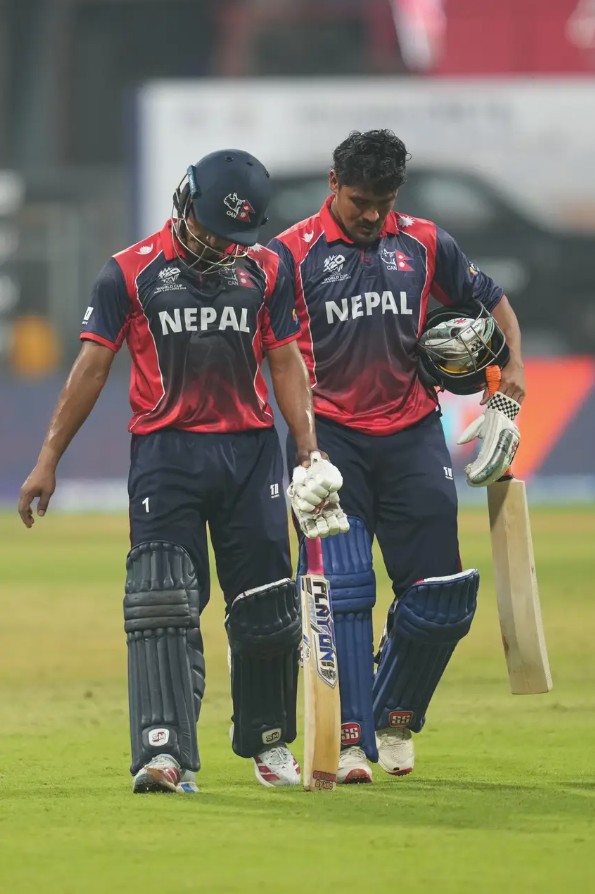
(Rafiq Maqbool/AP)
Lacking jeopardy
Knockout matches are a staple of sporting competition, though cricket tends to refrain itself from such high-pressured moments on the big stage.
Over a 55-match tournament, there are just three guaranteed winner-takes-all matches (semi-finals and final), even if final matches in the group or Super 8 stage may provide what are effectively knockout games.
The previous two editions of the 50-over World Cup have also had just three official knockout matches after a total of 45 group stage games, with often little riding on them towards the back end – a balance between the volume of cricket and entertainment factor of a tournament which has not quite felt right.
Quarter-finals are a rarity in the sport, not seen since the 2011 and 2015 World Cup, though would produce higher stakes and drama with no room for error, whilst also giving more hope to the lower-ranked and Associate nations to progress even further.
This would, in turn, increase the unpredictability and potential excitement of a global tournament more so than the T20 format does alone, which for many viewers would offset the loss of additional Round-Robin fixtures.
Less is more
In the upcoming FIFA World Cup this summer, there will be a total of 31 knockout matches (32 including the third-place play-off), representing nearly a third of the entire tournament – albeit a much larger pool of teams – where unexpected storylines are celebrated but here, the early exit of Australia will be met with disappointment by those in charge who will now not have a marquee fixture between the Aussies and co-hosts India as planned.
The Rugby World Cup in 2027 offers a much more comparative scale to ICC events with 24 nations competing across six groups of four, though rather than having the top two teams from all groups split into an equivalent two new groups of six, they have the four highest-ranked third place teams advance to a newly-created and more exciting Round of 16 knockout stage that rewards performance in the group stages (the same ratio of group stage to knockout matches as the FIFA World Cup).
Sometimes less is more. Cricket has a format unpredictable in nature and primed for global expansion, all the key ingredients needed, yet the ICC appears reluctant to relinquish their money-oriented control and provide a global event with the true essence of tournament sport at its heart – high-stake knockout matches.
READ MORE: England survive another scare to beat Italy and reach T20 World Cup Super 8s